| |
Fuels:
A Quick Reference Fact Sheet
| Fuel |
Pros |
Cons |
| Gasoline |
Widely
available |
Escalating
costs. Harmful emissions. Heavily dependent upon imported
oil. |
| Diesel |
Widely
available |
Escalating
costs. More toxic than gasoline. Heavily dependent upon
imported oil. |
| Biodiesel |
Domestically
produced fuel manufactured from vegetable oils, animal
fats or recycled restaurant greases. Can be used in diesel
engines. |
Increases
NOx emissions. Displaces some petroleum, still heavily
dependent upon imported oil. |
Natural
gas
(CNG and LNG) |
Two
of cleanest burning alternative fuels available. Virtually
non-toxic, contain almost no smog-forming hydrocarbons.
Can be used as feedstock to extract hydrogen. |
1,600
natural gas fueling stations in US, vs. 190,000 gasoline
stations. At present, natural gas vehicles (NGVs) cost
more than comparable gasoline or diesel vehicles |
| Electricity |
No
tailpipe emissions. Lower maintenance costs than gasoline-
powered vehicles. |
Very
expensive. Development stalled as battery storage technology
is inadequate. Niche off-road market. |
| Hybrid
gas/electric |
Effective
near-term solution for light-duty vehicles. Gasoline engine
combined with batteries/electric motor increase MPG. |
Not
available for heavy-duty vehicles. Escalating costs for
gasoline used. Harmful emissions. Heavily dependent upon
imported oil |
| Ethanol |
Alcohol-based
liquid fuel derived primarily from corn. Reduces dependence
on foreign oil. |
Requires
massive use of cropland to supply meaningful power. Huge
government subsidies, otherwise more expensive than gasoline. |
| Methanol |
Extracted
from natural gas as feedstock. |
Produces
formaldehyde, poisonous. Takes two gallons of natural
gas to make one gallon of methanol. |
Propane
(Liquefied Petroleum Gas or LPG) |
Produced
from natural gas processing and crude oil refining. |
Production
limited. Inefficient use of feedstock. Heavier than air,
dangerous to use. Costs prone to seasonal price fluctuation.
Niche market in rural areas. |
| Hydrogen |
Potentially,
may be produced in virtually unlimited quantities. Would
address concerns about energy security, global climate
change and air quality. |
Hydrogen-fueled
vehicle development and fuel processing technology just
getting underway. May not become commercially meaningful
until 2015-2020 or later. |
Comparison of Alternative
Vehicle Fuels Fact Sheet
There are a number of fuels that are being advocated as replacements
for gasoline and diesel in transportation applications. These
include: biodiesel, electricity, ethanol, LPG (propane), methanol
and natural gas (both compressed and liquefied). The following
is a brief discussion of the advantages and disadvantages
of each of these alternative fuels.

Biodiesel
Biodiesel is a domestically produced, renewable liquid fuel
that can be manufactured from vegetable oils (e.g., soy oil),
animal fats, or recycled restaurant greases. It is used in
compression ignition (diesel-cycle) engines. Blends of 20%
biodiesel with 80% petroleum diesel (called B20) can generally
be used in unmodified diesel engines. Biodiesel can also be
used in its pure form (B100), but this requires engine modifications
to avoid significant maintenance and performance problems.
Advantages:
Environmental: When blended with current diesel fuel
(i.e., diesel fuel with an average sulfur content of 350 ppm)
and used in older diesel engines, biodiesel reduces particulate
emissions, carbon dioxide and some air toxics.
Energy Security: Every gallon of biodiesel used displaces
one gallon of petroleum (although if the energy used in producing
the biodiesel is taken into account including the energy
used in producing the crops from which the biodiesel is made,
the net displacement is much less).
Vehicle Cost: Since biodiesel blends (B20 or less)
can be used in any diesel engine, there is no incremental
cost for the vehicle.
Other: Biodiesel is safe and biodegradable.
Disadvantages:
Environmental: Biodiesel use increases the production
of nitrogen oxides (NOx) somewhat. Given that most areas not
in attainment with National Ambient Air Quality Standards
(NAAQS) are not in attainment because of NOx levels, biodiesel
use exacerbates their problems. In addition, beginning in
2006, refiners will be required to produce and sell lower
sulfur diesel, and, beginning in 2007, heavy-duty engine manufacturers
must meet tighter emission standards. It is unclear whether
biodiesel use will produce any emission benefits when used
with the lower sulfur fuel in these new engines.
Energy Security: While vehicles that run on B20 displace
some petroleum, they are still 100 dependent on diesel fuel
to operate.
Operating Cost: Without government incentives, biodiesel
is significantly more expensive than diesel fuel.
Driving Range: Because there is less energy in a gallon
of biodiesel than in a gallon of petroleum diesel, the driving
range of vehicles operating on biodiesel blends is less.
Other: Even as B20, biodiesel use could void some OEM
and engine warranties. With the diesel engines that meet the
tighter 2007 emission standards, it is unclear whether the
engine manufacturers will warrantee these engines if used
with any biodiesel blend.

Electricity
As the term historically has been used, electric vehicles
are vehicles that operate solely on electricity that is produced
off the vehicle and stored on the vehicle in batteries. The
term electric vehicle also is now sometimes (confusingly)
applied to hybrid-electric vehicles and hydrogen fuel cell
vehicles.
Advantages:
Environmental: Since there is no combustion of fuel
on the vehicle, there is no pollution produced by the vehicle.
In addition, since electric vehicles are indifferent to the
source of electricity, electric vehicles can be powered by
electricity produced from renewable fuels (e.g., wind, solar).
Energy Security: Electric vehicles operating on electricity
produced from fuels other than petroleum displace the use
of foreign oil.
Operating Cost: Depending on the local cost of electricity,
operating costs can be less than gasoline.
Other: The vehicles operate very quietly.
Disadvantages:
Environmental: Depending on the fuel used to produce
the electricity to power the vehicle, total pollution can
be much greater than even gasoline and diesel vehicles. In
addition, the vehicles batteries must be replaced every
few years. Disposal of those batteries imposes a hazardous
waste disposal problem.
Vehicle and Maintenance Costs: When the automakers
(original equipment manufacturers or OEMs) were producing
them, the vehicles were very expensive to purchase. In addition,
the replacement batteries are expensive. The combination of
these two factors makes electric vehicles commercially uneconomic.
Refueling: Despite significant research, no one has
developed batteries (or other electricity storage technologies)
that recharge in a time comparable refueling a gasoline vehicle.
Battery recharging takes hours.
Driving Range: The driving range of electric vehicles
is very limited (about 100 miles on a charge.) Aggressive
driving and use of accessories (heater, air conditioner, radio)
further reduces the driving range.
Vehicle Availability: Because of cost and performance
issues, the major OEMs (Ford, GM, DaimlerChrysler) have discontinued
their electric vehicle programs. Only a few specialty manufacturers
still make electric vehicles.

Ethanol
Ethanol is an alcohol-based liquid fuel produced by
fermenting and distilling starch crops that have been converted
into simple sugars. The primary feedstock for ethanol today
in the U.S. is corn. Other feedstocks include barley and wheat.
Ethanol can also be produced from "cellulosic biomass"
such as trees and grasses and is called bioethanol. Ethanol
is most commonly used as a blend fuel (e.g., 1-3 percent)
to increase octane and improve the emissions quality of gasoline.
In some areas of the United States, ethanol is blended with
gasoline to form an E10 blend or gasohol (10% ethanol and
90% gasoline), but it can be used in higher concentrations
such as E85 or E95. OEMs produce flexible-fuel vehicles that
can run on E85 or any other combination of ethanol and gasoline.
Because of performance and safety problems, 100 percent ethanol
(E100) is not used.
Advantages:
Environmental: Ethanol blends reduce emissions of some
pollutants (e.g., carbon monoxide, and volatile organic compounds).
Energy Security: Ethanol is produced domestically from
renewable crops (see disadvantages below).
Vehicle Cost: No modifications need to be made to gasoline
vehicles to allow them to operate on E10 (or lesser) ethanol
blends. For greater blends (e.g., E85), OEMs need to make
only minor (and inexpensive) modifications to their vehicles.
Other: Since flexible-fuel vehicles can operate on
100 percent gasoline, they provide the flexibility to owners
to travel to and from areas where there are no ethanol stations.
Disadvantages:
Environmental: Use of ethanol blends does not reduce
NOx emissions and increases significantly the emissions of
aldehydes.
Energy Security: This continues to be a disputed issue.
Ethanol proponents argue that ethanol use displaces petroleum
use. There have been a number of studies, however, that demonstrate
that more energy (including petroleum and natural gas) is
used in the production of the ethanol than there is in the
ethanol.
Driving Range: Because there is less energy in a gallon
of ethanol than in a gallon of gasoline, the driving range
of vehicles operating on ethanol blends is less.
Operating Cost: Ethanol producers currently receive
a federal tax credit of 82 cents per gasoline gallon equivalent.
A number of farm states provide additional financial incentives
per gallon. Without government incentives, ethanol is significantly
more expensive than gasoline.
Fueling: The number of public fueling stations that
sell E85 is quite small and geographically limited. This fact,
plus the greater cost of E85 over gasoline, has resulted in
most flexible fuel vehicles operating solely on gasoline.

LPG
(Propane)
Liquefied petroleum gas (LPG) consists mainly of propane,
propylene, butane, and butylene in various mixtures. However,
in the United States, the mixture is mainly propane. It is
produced as a by-product of natural gas processing and petroleum
refining. The components of LPG are gases at normal temperatures
and pressures. However, they become liquid under moderate
pressure. Therefore, LPG is stored on vehicles as a liquid
in pressurized tanks.
Advantages:
Environmental: Propane vehicles produce less of virtually
all tailpipe pollutants than comparable gasoline or diesel
vehicles.
Energy Security: Most propane used in the U.S. today
is domestically produced.
Operating Cost: Propane costs less per gallon than
gasoline and diesel fuel.
Fueling: A national infrastructure of pipelines, processing
facilities, and storage already exists for the efficient distribution
of propane.
Disadvantages:
Energy Security: Propane production in the U.S. is
limited. If the demand for propane were to increase significantly,
the additional propane would have to be imported.
Operating Cost: Propane costs vary considerable throughout
the year usually peaking in the winter when demand
for residential heating is greatest. Unless a user enters
into an annual contract with a propane provider, this severely
complicates fuel cost budgeting.
Vehicle Cost: Primarily because of the cost of on-board
storage tanks, the cost of propane vehicles is greater than
for comparable gasoline and diesel vehicles.
Driving Range: Because there is less energy in a gallon
of propane than in a gallon of gasoline or diesel, the driving
range of vehicles operating on propane is less.
Fueling: Compared to gasoline and diesel fuel, the
number of propane fueling stations is limited.
Vehicle Availability: Only a couple of propane vehicles
are still being manufactured by OEMs. Most propane vehicles
produced today are aftermarket conversions.

Methanol
Methanol (CH3OH) is an alcohol fuel. Today, most of the world's
methanol is produced by a process using natural gas as a feedstock.
However, the ability to produce methanol from non-petroleum
feedstocks such as coal or biomass is of interest for reducing
petroleum imports.
When methanol was being used as a vehicle fuel, it was used
in a blend of 85 percent methanol and 15 percent gasoline
(M-85). Vehicles can operate on neat methanol (M-100), but
because of performance and safety issues (e.g., M-100 burns
with an invisible flame), M-100 is not used for on-road vehicles.
Methanol internal combustion engine vehicles were at one time
viewed as the primary alternative to petroleum. Because of
performance and other problems, this is no longer the case.
No commercially available methanol vehicles are available
today.
Advantages:
Environmental: Vehicles operating on methanol blends
produce fewer NOx, VOCs and CO emissions than comparable gasoline
vehicles.
Energy Security: Methanol is made primarily from natural
gas, 85 percent of which is produced in the U.S., with virtually
all the rest produced in Canada.
Vehicle Cost: If OEMs were to produce M85-capable vehicles,
they would need to make only minor (and inexpensive) modifications
to their vehicles.
Disadvantages:
Environmental: Methanol vehicles produce a significant
amount of formaldehyde.
Safety: Methanol is highly corrosive and toxic when
ingested or absorbed through the skin. Public refueling would
be very problematic.
Fueling: There virtually are no public methanol fueling
stations.
Vehicle Availability: No one now manufactures methanol-powered
vehicles.
Operating Cost: Today, methanol is made primarily from
natural gas. Because of the energy losses in the conversion
process and the cost of domestic natural gas, M85 is much
more expensive than gasoline.
Maintenance Cost: Because of methanols corrosive
qualities, engine parts needed to be frequently replaced.
Energy Security: Even with the greater shipping cost,
it is much less expensive to produce methanol at sites around
the world where the price of natural gas is much less than
to produce the methanol in the U.S. If methanol were to be
become a significant transportation fuel, most of it would
be imported.
Driving Range: Because there is less energy in a gallon
of M85 than in a gallon of gasoline, the driving range of
vehicles operating on M85 is less.

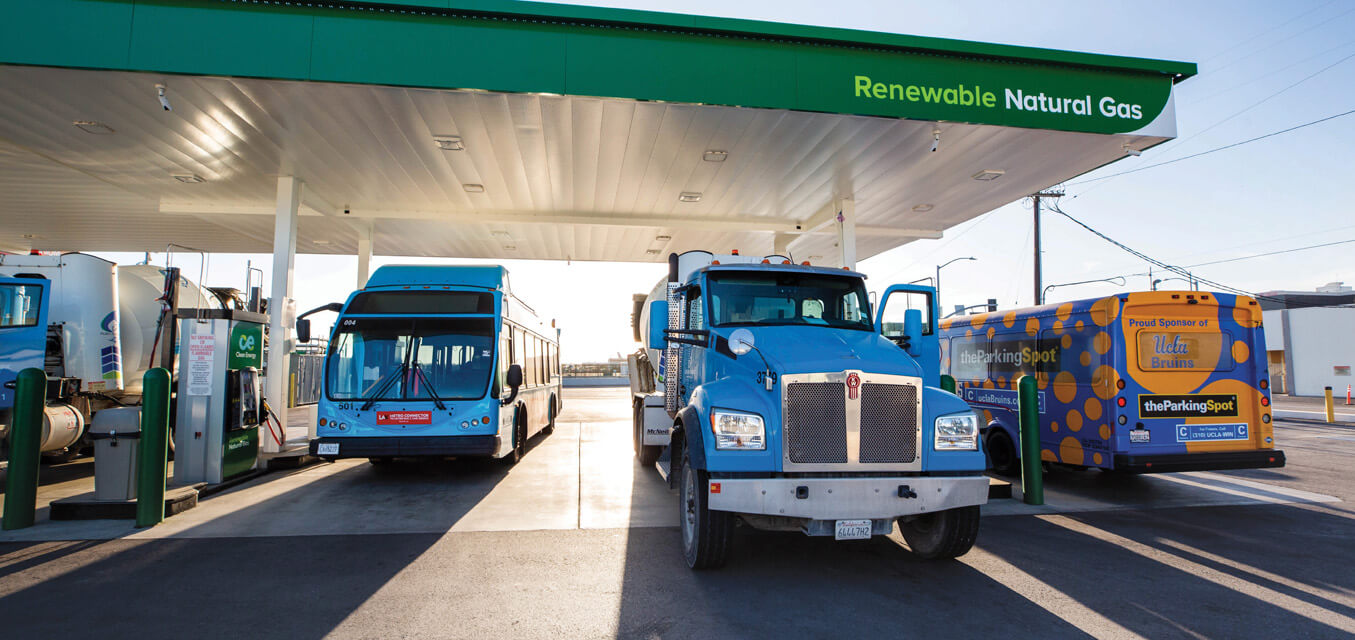
Natural
Gas (Compressed or Liquefied)
Natural gas consists mostly of methane and is drawn
from gas wells or in conjunction with crude oil production.
Compressed natural gas (CNG) vehicles store natural gas in
high-pressure fuel cylinders at 3,000 to 3,600 pounds per
square inch. Since natural gas is colorless, odorless and
tasteless, an odorant is normally added to CNG for safety
reasons. Liquefied natural gas (LNG) vehicles store natural
gas as a cryogenic liquid.
Advantages:
Environmental: CNG vehicles produce far less of all
regulated pollutants that compar-able gasoline or diesel vehicles,
including NOx and particulate matter. In addition, CNG vehicles
produce far less unregulated air toxics and greenhouse gases.
Energy Security: Natural gas is primarily a domestic/North
American fuel, 85 percent of which is produced in the U.S.,
with virtually all the rest produced in Canada.
Operating Cost: Natural gas is cheaper "at the
pump" than gasoline and diesel fuel. Prices vary around
the country.
Vehicle Availability: There are over 50 natural gas
vehicle models available for light-, medium- and heavy-duty
applications. This is more than for any alternative fuel.
Distribution Efficiency/Safety: America has a natural
gas transmission and distri-bution network of over 1.5 million
miles bringing natural gas to every major city in the country.
This is the safest and most efficient energy distribution
system.
Flexibility: CNG vehicles can be (and are being) produced
as dedicated and bi-fuel versions. Dedicated vehicles are
most appropriate where vehicles tend to operate in an area
where natural gas fueling is available. Bi-fuel vehicles have
both natural gas and gasoline storage tanks on board, and
can operate on either fuel at the flip of a switch. Bi-fuel
vehicles are most appropriate where the driver may need to
travel to areas not currently served by natural gas stations.
Home Refueling: The majority of homes in the U.S. are
connected to the natural gas transmission and distribution
system. Through the use of a "home refueling appliance,"
homeowners can refuel their CNG vehicles at home.
Transition to Hydrogen: Since hydrogen is a gas, hydrogen-powered
vehicles will require changes in a number of areas, including
building codes and standards, mechanic/ inspector/user training.
NGVs require many of the same changes. Therefore, a growing
NGV market today is smoothing the path for a hydrogen vehicle
market tomorrow.
Disadvantages:
Fueling: There are only 1,600 natural gas fueling stations
in the U.S. (compared to 190,000 gasoline stations). In addition,
each station costs significantly more than for a comparable
gasoline/diesel dispenser and storage tank system.
Vehicle Cost: Primarily because of (1) low production
volumes and (2) the greater cost of fuel storage tanks, NGVs
cost more than comparable gasoline or diesel models.
Driving Range: Compared to a volumetric gallon of gasoline
or diesel fuel, there is less energy in an energy gallon equivalent
of natural gas (both CNG and LNG). Therefore, the driving
range of vehicles operating on natural gas is less.
Other: On-board natural gas fuel tanks are larger than
comparable gasoline or diesel fuel tanks. Therefore, in some
vehicles, some cargo or truck space is lost.
Download a pdf
Back to top
|
|